Monday, April 11, 2011

Grown Materials

So our group is currently looking at the idea of Wellington moving from inflatable architecture in say ten years time, but that by 2040 the materiality of the buildings is something that can be grown which is more environmentally friendly and biodegradable than conventional building methods. I have taken on the role of looking into grown materials (since I have already sent an email to get in contact with a scientist relevant to the area) and how they could be adapted to become a shell on current building structures.

A breakdown of how I currently see it -

We want -
- An organic material to grow over the current foundation of a building (concrete) as a kind of shell . This will be over passage ways between buildings and perhaphs eventually be the main material of building structures.
- A material that the building aids to grow at first but then is able to grow on its own.

In the future past 2040 - Passage ways can possibly be shifted to be between other buildings or when not wanted can degrade in a forest much like leaves.

Why this material -

- The organic material brings more vegetation into the business district and meshes with the 'eden garden' idea that is to be within these passage ways.
- Is more environmentally friendly by using less materials that are used with conventional building methods.

Ive started researching into what materials could be used...

First looking at vines like Ivy, Russian-vine and virginia creeper but then talking to the group again decided we don't want a plant like vines growing on the outside of the buildings but rather just a material that can act like a shell that will eventually replace the PVC material thats the inflatable archiecture.
----
Watching the Ted talks video again that Ross showed us in class...

It mainly talks about mycelium, a self assembly organism that does the work in the process of something growing. The benifits of it are that at the end of its life it can be composted into the garden. The group that came up with it believes that better materials should be able to be created anywhere on the planet, use less energy to produce than normal materials and be able to be disposed by nature. So this got me thinking if i have a grown material, mycelium could somehow be intergrated into it to have it grow in a more controlled way - into a shell that would cover the building structure.


The website for it -
http://www.ecovativedesign.com/

I have no idea if this is even possible but just putting the idea out there - could something like mycelium substance be integrated into the DNA of cicada wings or other organic things to control / change the rules in which they grow. Perhaphs also make them stronger so eventually they can serve as a main building structure.

Starting to do some research into cicada wings and found this page that documents experiments carried out on the materiality of cicata wings-

http://iopscience.iop.org/1748-3190/6/2/026003/pdf/1748-3190_6_2_026003.pdf
From its research it draws conclusions that cicata wings have anti-reflective and wetting properties from the hexagonal nanostructure of the wings. It is said that the wings filter out ultra violet light.
http://www.energyharvestingjournal.com/articles/improvements-to-solar-cells-come-from-moths-and-cicadas-00002508.asp?sessionid=1

May be good to have this translucent material as this main shell that wraps over the building structures.

Friday, April 8, 2011

Contacting Experts

So have been looking for experts in the area of biominerlisation for someone to be able to back some of the ideas we have about buildings and passage ways eventually being able to be grown from plants. Have been googling and found this guy specialising in biominerlisation in Chile -

http://www.linkedin.com/in/ranjithkrishnapai

The part that stood out in his summary was - "My research efforts will provide an interdisciplinary research environment and goal is to use biological principles as guidance in developing new, bio-inspired synthetic routes and nanofabrication strategies that would lead to advanced materials and devices". As we are interested in how we can use plant materials in advanced ways to create building structures.

http://www.cimat.cl/cvs/cvrpai.xml - his online resume where his email is located.

So I have initially emailed him the following from my Vic email address...

Dear Ranjith Krishna Pai,

We are a group of Victoria University students currently in our final year doing a design research project for the New Zealand Government’s Wellington City Council. We are creating a design vision for Wellington City 2040, as a part of our course Design Led Futures. They are looking to us for our design vision of the future, but we need some research to back up our proposal. We have been advised to contact professionals in the relevant areas for their knowledge to validate some of our ideas.

We decided to contact you because we understand that you have done extensive research in the area of biominerlisation.

We are trying to bring more fun into the central business district by creating inflatable architecture between high rise buildings.Today you can use PVC but we are looking for something to substitute this which is more environmentally friendly and biodegradable. We hope to grow these buildings and passage ways in the future rather than using conventional building methods and materials.

Would you have the time to answer a few questions relating to biominerlisation? We would be very grateful to have your insight.

Kind Regards,

Xanthe Flesch


Xanthe Flesch
Fourth Year Digital Media Design
Faculty of Architecture & Design
139 Vivian Street, Wellington,
New Zealand

------

Hopefully if he replies I can go on to ask the following questions that Jason helped me form as the kind of things we would like to hear from him about -

- Where do you see the future of your materials research in thirty years time?

- Do you believe we will be able to grow materials into forms like buildings rather than using conventional materials and construction techniques in the future?

- What is currently the most advanced material of growing organic and inorganic materials?

The questions were originally going to be in the first email but Cornelia made a good point when she proof read it for me that you don't want to hound them with questions in the first email, but rather establish who you are, what you are doing and whether they would be interested in answering a few things for you.

Still planning on contacting some more people in this area though incase some don't reply...

Thursday, April 7, 2011

Inflatable Structures


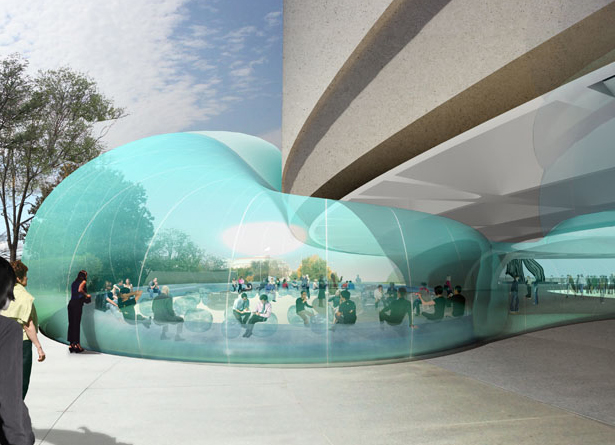
Inflatable Expansion to the Hirshhorn Museum, Designed by Diller Scofidio + Renfro. It is an inflatable structure that oozes from the top and bottom of the building and is used as an event space. Architects are working towards the first installation of the temporary inflatable pavilion in May 2011.

An inflatable room designed for space! It involves a 30cm-thick sandwich of polymers to protect against space debris and micrometeorites. Must be strong if it is meant for space...


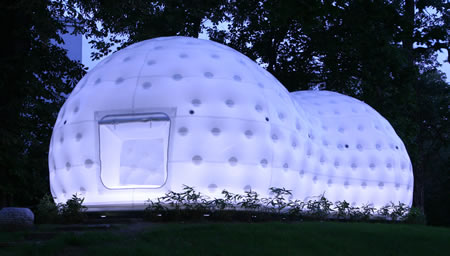
Kengo Kuma - Inflatable Tea House 2007. 

Wednesday, April 6, 2011

Tomás Saraceno

While I was searching the web for some inflatable structures to use as inspiration/precedents, I came across an artist named Tomás Saraceno who creates inflatable architecture, luminous installations, kinetic sculptures and suspended gardens. He has a background in architecture and his biospheres work can be seen as alternative, conceptual types of social spaces and habitats for human beings.

What I found interesting about all his work is that they relate very closely to our idea of creating a city with inflatable structures. Although his installations are conceptual, they are a great starting point for us to branch our ideas off of.

"Utopia exists until it is created" - Tomás Saraceno. I found it a little amusing finding this quote after listening to Margaret's lecture today. But I do agree with this statement; judging from the examples that Margret brought up today, Saraceno's quote seems pretty plausible.


Some of Tomás Saraceno's works:

On Air, 2004. - Air under pressure, PVC, humans.


Cumulonimbus, 2006. - Net, PVC, Air under pressure, Humans.

Biospheres, 2009. - Inflatable modules, acrylic, rope, plants, water


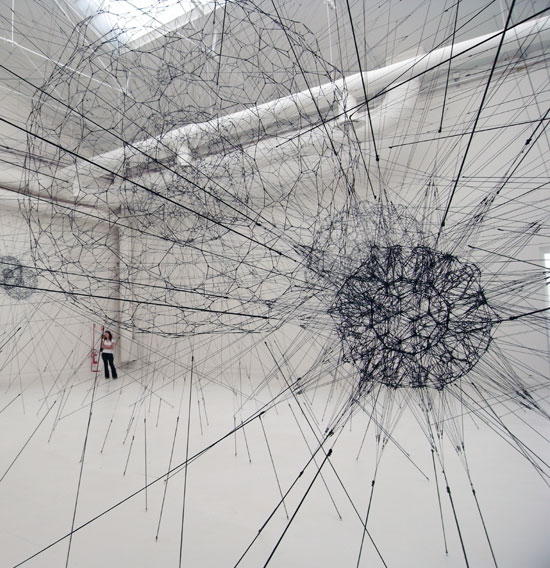
'Galaxies forming along filaments, like droplets along the strands of a spider's web,' 2009.

Wednesday, March 23, 2011

Bubble Experiment Analysis

Between the Buildings


We managed to find a nice and narrow alleyway to set up our bubble, which illustrates our idea of having inflatable structures between structures that help reinforce buildings, as well as creating walkways or linking bridges that could connect buildings together on different floors.

Midland Park


As we were setting up the bubble in the middle of the park during the lunch rush, no one payed any close attention to what we were doing. There were a few people who looked over, but most of them just minded their own business, which was quite surprising. This suggests that the environment around that area is much more serious and not as lively. As Justin put it, it was like everyone at the park was in their own metaphorical bubble and not bothering to pay attention, while we were all inside this physical bubble and having fun.


Cuba Mall


We tried the same experiment on Cuba Mall and the reactions that we got while we were setting up were completely opposite to Midland Park. There were lots of people coming up to us asking what was going on and why we were doing this. The public likes to engage more with interesting things on Cuba street, which is what makes it a fun and friendly atmosphere. This suggests that Cuba Mall is a much more relaxed and lively place compared to Midland Park.

Urban Jungle Gym's aim is to analyse what makes the recreational places around Wellington (e.g. Cuba Street) a fun environment, and bring those elements into the serious, business orientated areas (e.g. Lambton Quay), to create an overall recreational city.